

Many of you are new here, so I wanted to share a bit of how The Daily Press began.
It didn’t start with a product idea. It started with a question.
“What’s your skincare routine”
It seems like the most harmless question, but if you're anything like me, I'd almost feel embarrassed and mumble, “Umm, very basic. I use one or two things.”
I own it now, but I still see that same self-consciousness reflected on other people's faces when I ask the question. Almost apologetic for not having a 10- step routine. Not knowing what retinol is or knowing the latest derivative.
People apologize for simplicity. They feel like they’re falling short because the industry taught them that more steps equal more care, more knowledge, more sophistication.
Self-care long left the chat.
I never planned to build a skincare brand. A year ago if you told me this is what I would be doing, I would have laughed it off.
So, then why skincare?
Somewhere between moving between Singapore and the US, watching my skin react differently to every climate, every product, every well-meaning recommendation - I stumbled onto a gap so obvious I couldn’t look away.
There’s a specific kind of tired that hit me in my 30s.
It’s not dramatic. Nobody warned me about it. My skin became drier, more reactive, more particular. A tester at a counter that would’ve been fine at 25 left me with a rash at 31. What once felt like a treat - a free sample, a tester - now makes me jittery.
Scents I had trusted for years started giving me migraines.
And what used to feel like play, the trying, the discovering, the little ritual of it, started feeling like a minefield.
Life already felt chaotic enough without rearranging it around a skincare routine.
And then, in your 30s, the word anti-aging enters the conversation. The industry makes it sound as though I can negotiate with biology if I just buy the right night cream.
What surprised me wasn’t that my skin changed. It was how much room it took up in my head. Every purchase felt like a decision I might get wrong.
It was how much mental energy I suddenly spent thinking about it.Every purchase felt daunting. I had to be wary of pea size amounts. Use in a certain order and time.
I started to feel less like a person being cared for and more like a problem being solved.
What’s in a date?
It didn’t start with dates. It started with ingredients. I began deciphering ingredient lists, learning what each active actually does, trying to tell the science apart from the marketing. Trying to understand fragrance, colors, preservatives, endocrine disruptors and so on and on.
Suddenly I couldn’t find one detail which we never talk about in skincare: when the thing was actually made. On the US products I couldn’t find it at all. On the Singapore ones I could, and the maths said the bottle in my hand was already several months/years old. I assumed I’d misread something, so I checked another. Then another.
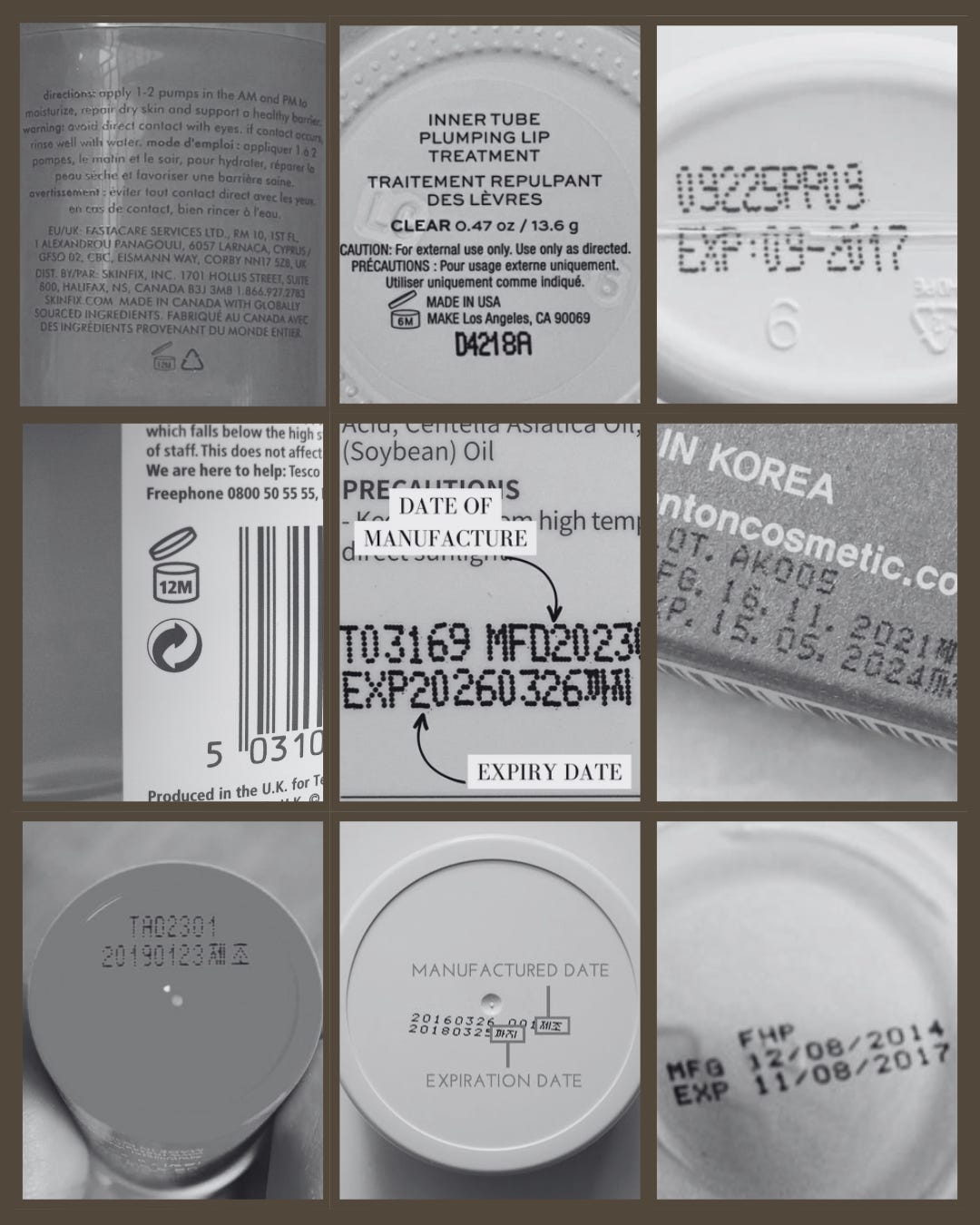
Most of these never tell you when they were made. And the ones that do last for three years. And a formula built to last three years can be sold to you at any point across those three years - day one, or month thirty-five.
Pick up any product on your shelf. Find the manufacturing date. It’s there, technically. At least in some countries. Buried in the smallest font legally allowed, on the bottom, almost apologetic. Do the maths. That “fresh” formula could be years old.
I’d spent real money on products I couldn’t bring myself to throw away. They sat on my shelf, half-used, quietly aging. And I had no idea how old they already were when I bought them. And those chemical-sounding words I once took as a signal of advanced science suddenly felt less reassuring.
On the other side: the wellness brands. All feeling. All ritual. All soft lighting and words like nourish, glow, and radiance. Beautiful. But when you turned the bottle around, the ingredient list told a different story.
The transparency wasn’t there. The science wasn’t there. It was spa theater, and I’d seen behind the curtain.
I went down the rabbit hole half-hoping I’d discover I’d misunderstood something. I hadn’t.
Once I saw it, I couldn’t un-see it.
Fresh matters because it reflects respect.
Here’s something it took me embarrassingly long to notice.
I’ll walk twenty minutes for flowers cut that morning, and I judge a coffee by its roast date like it’s a personality trait.
But the serum I’d been leaving on my face twelve hours a day? I couldn’t have told you how old it was within a year.
Turns out, that's not an accident. The age of most skincare isn’t a fact of chemistry but a decision made about warehouses and margins, and how long a bottle needs to survive the trip to you. Most preservatives are there for the supply chain, not your face. The ingredient list is determined based by how long the product needs to last on a shelf - 3 years.
And that commitment has consequences. Real ones.
Fresh is a decision, not a fact.
You won’t find The Daily Press on a shelf. We don’t stockpile. We can’t. The whole point falls apart the moment we do. So we work on a members list. You join the members list, and we ship fresh. Every time.
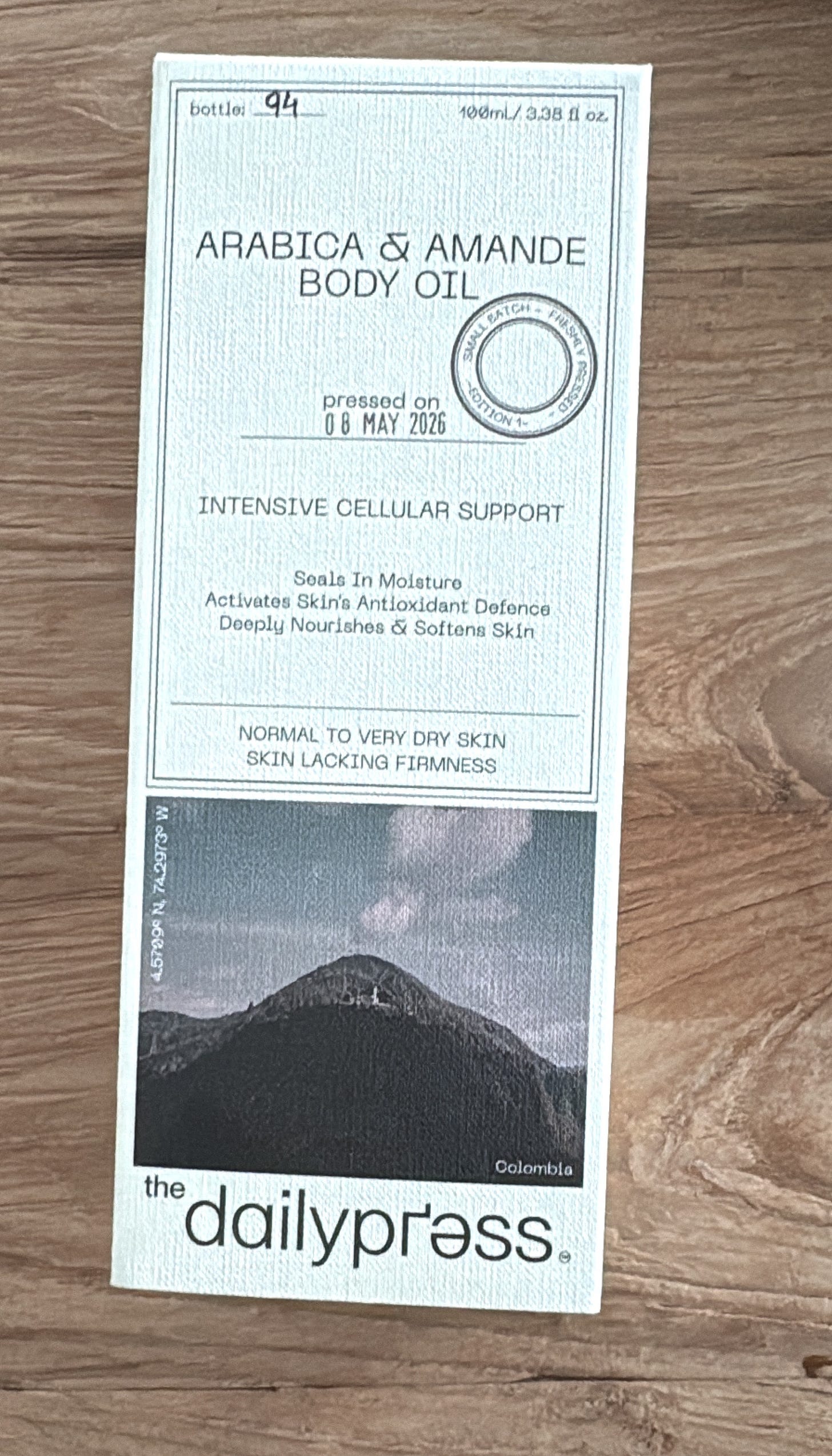
Pressed on 08 May 2026, bottle 94, dated the day it was made and made for months not years. No decoding required.
That’s not a limitation. That’s the proof.
Fresh isn’t really the point.
Trust is.
Knowing what you're putting on your skin. Knowing when it was made. Knowing the company behind it made choices with you in mind.
We trust fresh coffee. Fresh flowers. Fresh food.
It’s time we start asking the same thing from skincare.
So we’re building a company around the idea that we should.
Best,
Nehal,
Founder, The Daily Press